The most expensive mistake an RV owner can make in Minnesota costs about two gallons of antifreeze to avoid. Skip it, and the first sound you hear in spring is water spraying behind a wall you can’t reach.
Water expands by about 9% when it freezes. [1] That one fact is the reason a forgotten cup of water in a low-point drain line can split a fitting wide open by February.
In central Minnesota, winterizing isn’t a maybe. It’s the difference between rolling out clean in May and opening the door to cracked pipes, a dead battery, and a chewed-up wiring harness.
This is the full checklist we walk customers through every fall. Work top to bottom and your rig will be ready when the roads thaw.
Why Minnesota Winters Are Brutal on a Stored RV
St. Cloud sits below freezing for just over three months a year, from late November into early March. The average January low is about 5°F. [2]
That’s the average. Minnesota’s all-time record low is 60 below zero, set at Tower in 1996. [3] Your RV plumbing has to survive whatever the season throws at it, not the typical day.
Here’s the physics that makes it dangerous. As water freezes inside a sealed pipe, it expands and pushes the remaining liquid into a smaller and smaller space.
Once ice blocks the line, University of Illinois research found that trapped water pressure behind the blockage can climb to about 4,000 psi. [4] Copper, PEX, and plastic fittings all give out long before that. The crack you find in spring was set in motion on the first hard freeze.
When Should You Winterize Your RV in Minnesota?
Do it before the first sustained freeze, not after. Around St. Cloud, the first fall freeze typically lands in the last week of September. [5]
You don’t need to panic at the first frost. But once overnight lows start dipping into the 20s and staying there, your window is closing.
RV pipes can freeze in a single cold night once temperatures drop into the teens. If your rig is already parked and you’re waiting on a free weekend, move it up the list. October is the safe month to have everything done in our area.
How Do You Protect the Water System from Freezing?
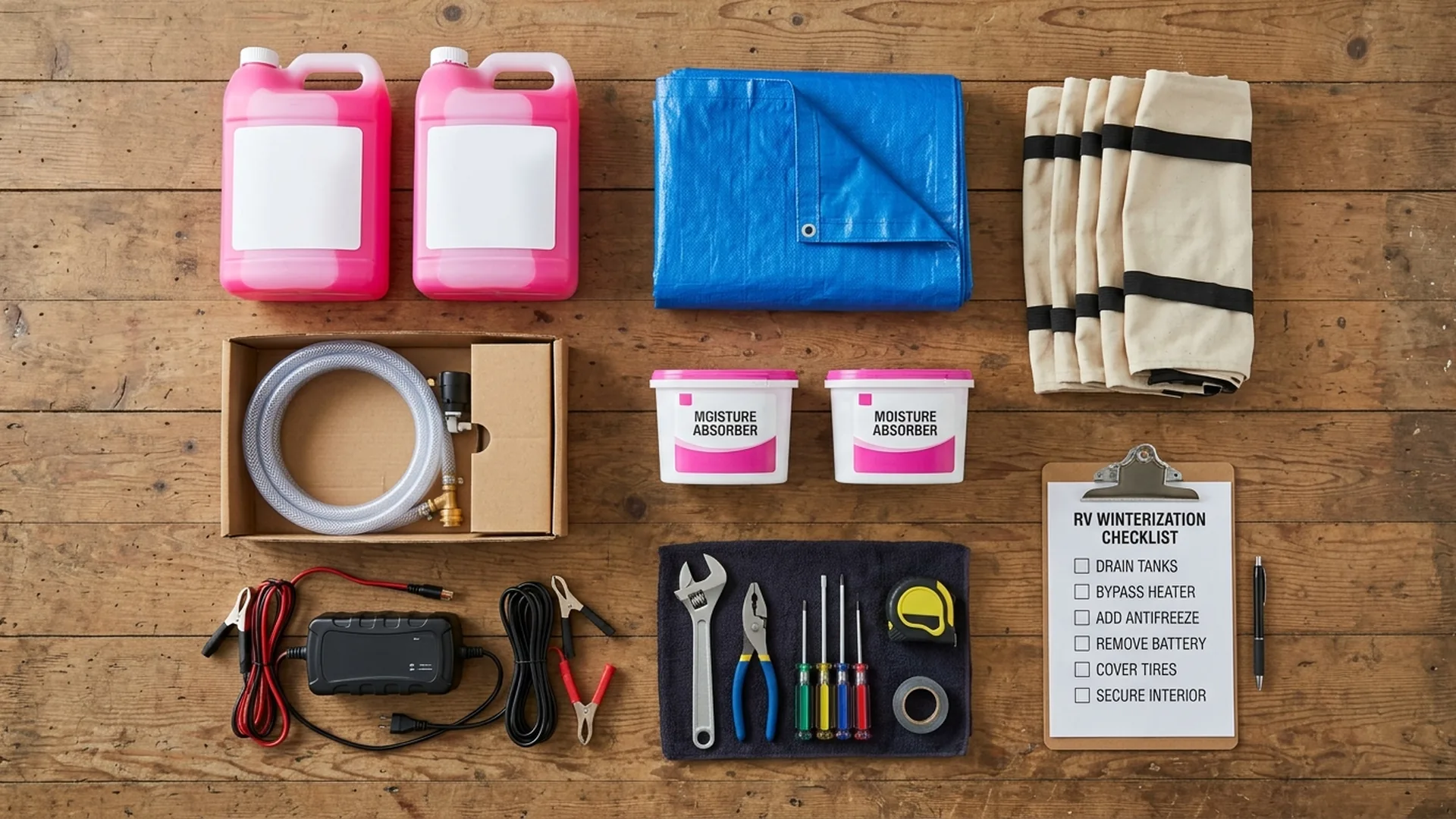
The plumbing is where winter does the most expensive damage, so this is the part to slow down on. The job has three stages: drain, bypass, then fill the lines with antifreeze.
Drain Everything First
Start with empty tanks. Dump the black tank, then the gray tank, then drain the fresh water tank completely.
Open both the hot and cold low-point drain lines. Open every faucet, inside and out, including the outdoor shower and the toilet valve. You want gravity to pull out as much water as it can.
Run the water pump for a few seconds to clear it, then shut it off. Don’t let it run dry for long, since that can damage the pump.
Bypass the Water Heater
Your water heater holds 6 to 10 gallons. Filling that tank with antifreeze wastes money and you’d just drain it in spring anyway.
Most RVs have a bypass valve behind an access panel. Set it to bypass so antifreeze skips the tank and goes straight to the lines.
Before you do, drain the water heater itself. Pull the drain plug or anode rod with the system depressurized and a faucet open, and let it empty fully.
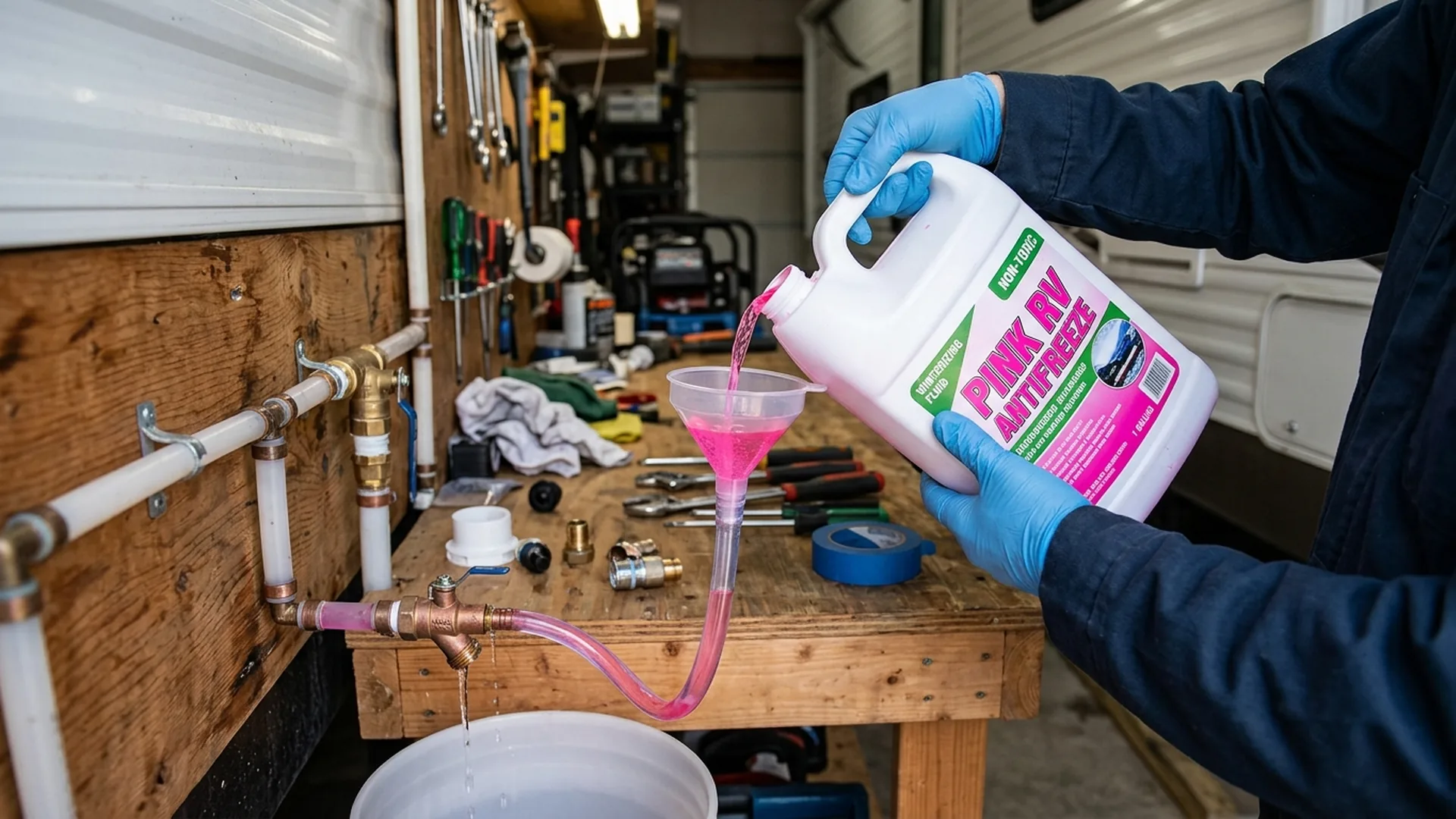
Add Non-Toxic RV Antifreeze
Use pink RV and marine antifreeze, which is non-toxic propylene glycol. Never use the green or orange automotive stuff, since ethylene glycol is poisonous and you’ll be drinking from these lines later.
Winnebago’s guide calls for about two gallons for a typical rig, though larger trailers with a second bathroom need more. [6] Buy an extra jug so you don’t run short halfway through.
Quality matters here as much as quantity. Camco’s RV antifreeze carries -50°F burst protection (and -30°F freeze protection), which gives you real margin against a central Minnesota cold snap. [7]
The cleanest way to get antifreeze into the lines is a hand pump or the water pump’s winterizing kit, which draws straight from the jug:
- Connect the pump’s siphon hose to a fresh jug of antifreeze.
- Open one faucet at a time, hot then cold, until pink fluid runs steady.
- Work from the faucet nearest the pump to the farthest one.
- Don’t forget the toilet, the outdoor shower, and the washer hookups if you have them.
- Pour a cup of antifreeze down each sink and shower drain to fill the P-traps.
- Pour a couple of cups into the toilet and flush so it coats the bowl seal and holding tank.
When every fixture runs pink, the system is protected. That visible color is your confirmation that the line is full and no water pocket is left to freeze.
What About the Fuel, Engine, and Generator?
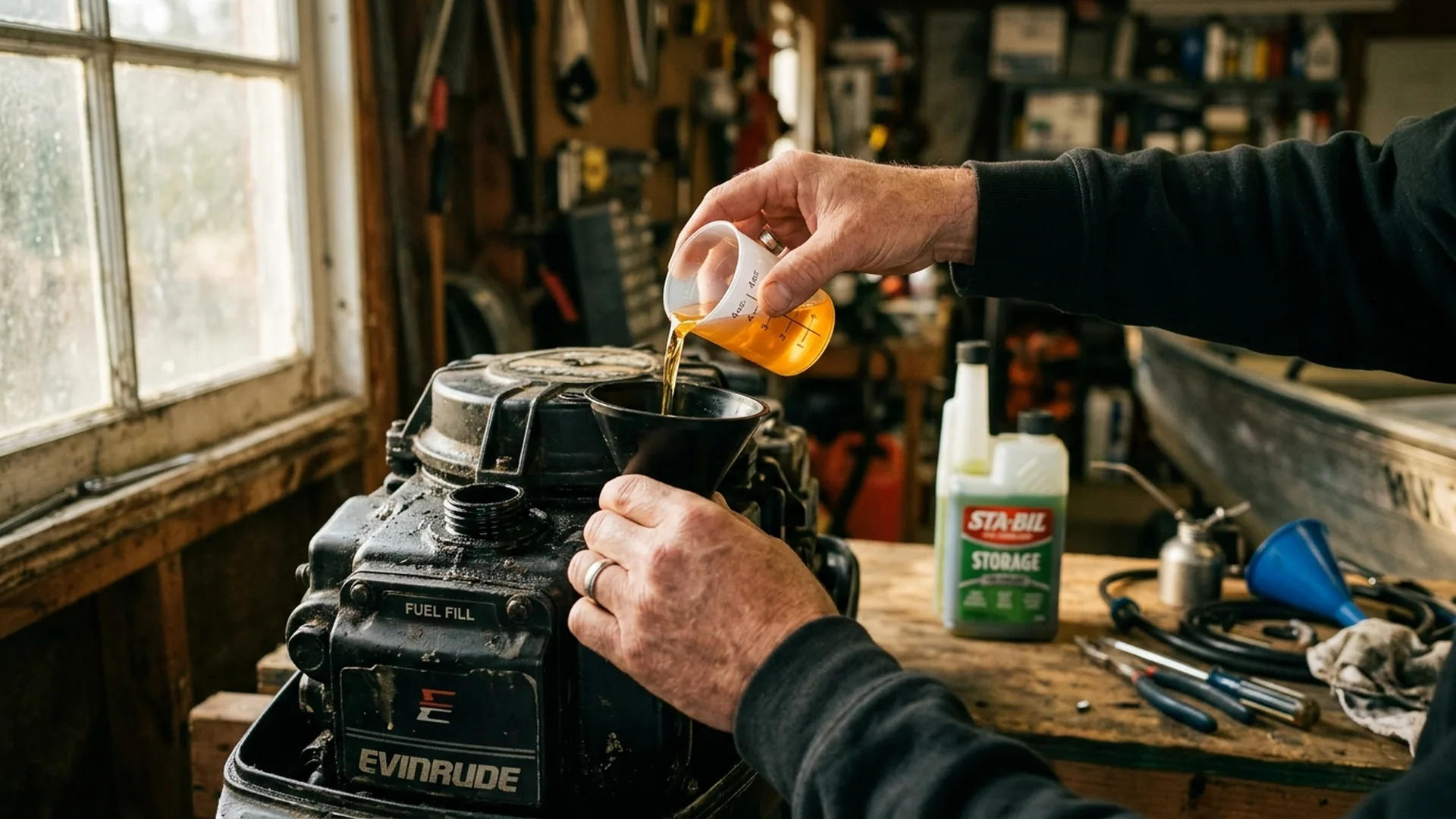
Gasoline doesn’t keep. As it ages, it gums up carburetors and injectors, which is why STA-BIL recommends treating any fuel you’ll store for 30 days or longer. [8] Over a five-month Minnesota layup, untreated fuel can turn into a spring repair bill.
The fix is cheap. Add a fuel stabilizer, which keeps gas fresh for up to 24 months, and fill the tank to about 95% full. [8] A nearly full tank leaves little room for the air that causes condensation and water in the fuel.
After you add the stabilizer, run the engine for about five minutes. That pulls treated fuel through the lines, pump, and carburetor or injectors so the whole system is protected, not just the tank.
Got an onboard generator? Run it under load for a few minutes with stabilized fuel too, then follow your manual on the fuel shutoff. A generator that sits on stale gas all winter is a common no-start in spring.
How Should You Store the RV Battery for Winter?
Cold and a low charge are a bad combination. A fully charged lead-acid battery resists freezing down to roughly -80°F, but a fully discharged one can freeze at about 20°F, and a frozen battery is usually cracked and finished. [9]
So the order matters: charge it fully first, then deal with storage. A battery that goes into winter at full charge has a huge safety margin even in an unheated space.
You have two good options. Pull the battery and store it somewhere it can stay topped off, or leave it in place on a smart maintainer if your storage has power.
If you disconnect, remove the negative cable first to avoid shorting a wrench across the terminal. Batteries slowly self-discharge on their own, so a maintainer or a monthly top-off keeps a stored battery from quietly dying before April.
How Do You Keep Tires and Propane Safe in Storage?
Tires lose air and take a set when a heavy rig sits in one spot for months. Michelin’s guidance is to keep tires at the pressure on the placard, not over-inflated, and to keep them away from heat and chemicals. [10]
For a long static layup, the gold standard is taking weight off the tires. Blocking the frame up on jack stands removes the load and helps prevent flat-spotting and sidewall stress.
If you can’t block it up, at least set correct pressure, park on boards instead of bare ground or grass, and use tire covers to block UV. On a sunny outdoor lot, those covers also slow the cracking that cold and sunlight cause together.
Propane Tanks
Cold itself doesn’t hurt propane. The rules are about ventilation and a closed valve.
Close the cylinder valve fully by turning it clockwise, and store removable tanks outdoors in a ventilated spot, never inside the RV or a closed garage. [11] Cap the connection to keep moisture and debris out of the fitting.
How Do You Keep Mice Out of a Stored RV?
This is the damage owners forget about, and it’s brutal. Mice chew wiring, nest in upholstery, and shred insulation, and many RV policies treat the result as preventable maintenance rather than a covered loss. [12]
It gets worse. A lot of modern wiring uses soy-based insulation that rodents are drawn to, and a single chewed harness can run from several hundred dollars up to roughly $2,900 to fix. An ounce of sealing beats that every time.
Before you park, walk the underside and find every gap where a pencil could fit. Mice get through openings far smaller than you’d guess.
- Stuff steel wool or copper mesh into gaps around plumbing and wiring pass-throughs.
- Remove all food, including the forgotten pantry stuff and pet treats.
- Empty cabinets, leave a few doors cracked, and skip leaving soft nesting material out.
- Set traps or place deterrents in the cabinets and underbelly as a backstop.
Don’t Forget the Roof, Seals, and Cover
The last walk-around is the exterior. Minnesota snow load and ice work on any weak seam all winter, and a small gap in fall becomes a leak by March.
Inspect the roof seams, the seals around vents and skylights, and the caulking along every edge. Reseal anything cracked or lifting before water has a chance to get under it.
Then cover the rig. A breathable RV cover sheds snow and blocks UV without trapping the moisture that causes mildew. If you store outdoors, plan to clear heavy snow off the roof after big storms so the load doesn’t sit on those seams for months.
What We See at Due North Storage
Most spring problems we hear about trace back to one skipped step the fall before. The two biggest are a water system that never got antifreeze and a battery left to die in the cold.
The freeze damage is the painful one. A burst line hides until you pressurize the system in spring, and then it’s leaking behind a wall or under the floor. That repair dwarfs the cost of two gallons of pink antifreeze.
The pattern we notice? The folks who store indoors with power barely think about any of this. Battery stays on a maintainer, the rig stays dry, and mice and snow load never enter the picture.
Store your RV somewhere winter can’t reach it.
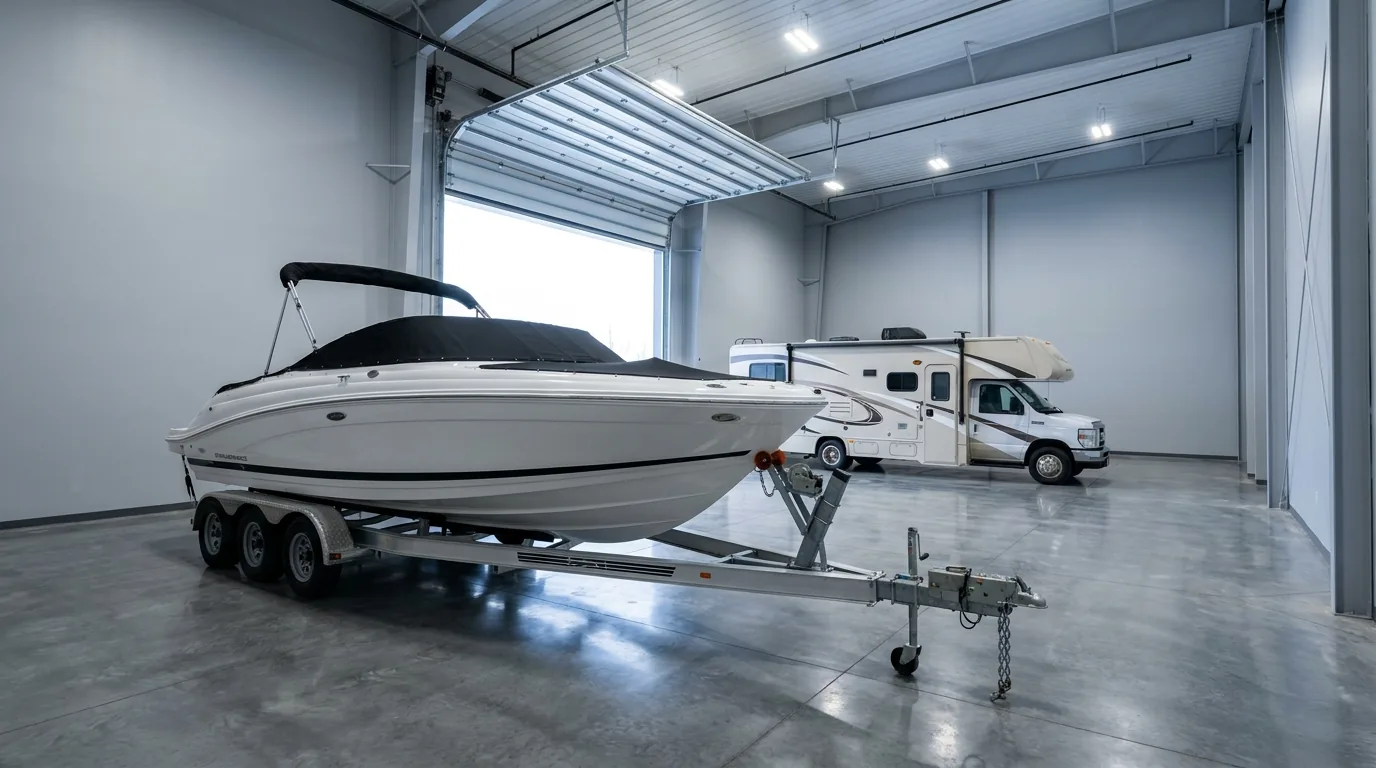
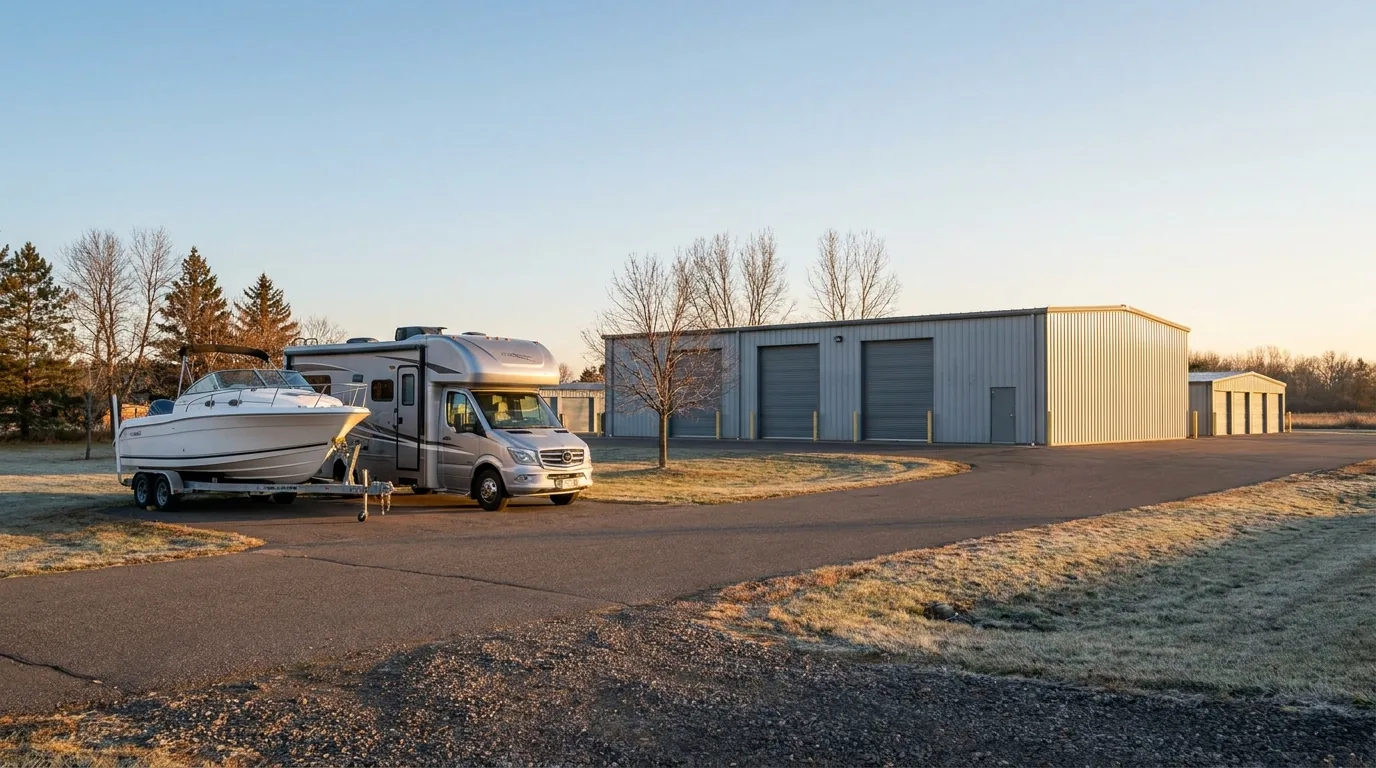
Due North Storage offers indoor units up to 14×40 with electricity included, just off Highway 10 in the St. Cloud area. Keep your battery charged and your rig out of the snow all winter.
Final Thoughts
Winterizing an RV in Minnesota isn’t complicated, but the order and the details decide whether you spend spring driving or repairing.
Protect the water lines, charge the battery, stabilize the fuel, and seal out the mice. Do those four things well, and the rest is housekeeping.
The same logic carries across the rest of the fleet, so if you’re also putting away a boat or a camper, the freeze rules don’t change. A little work in October buys you a clean, ready rig the day the roads open back up.
Frequently Asked Questions
How Much Antifreeze Do I Need to Winterize My RV?
Most RVs need about two gallons of non-toxic pink RV antifreeze, according to Winnebago’s winterizing guide. Larger trailers with a second bathroom or a washer can need three or more.
Buy an extra jug so you don’t run short, and make sure it’s propylene glycol rated for at least -50°F burst protection for a Minnesota winter.
Can I Use Regular Automotive Antifreeze in My RV?
No. Automotive antifreeze is ethylene glycol, which is toxic, and it would contaminate the same lines you drink and cook from later.
Only use pink RV and marine antifreeze, which is non-toxic propylene glycol made for potable water systems. The two are not interchangeable.
When Should I Winterize My RV in Central Minnesota?
Aim to finish by mid to late October. The first fall freeze around St. Cloud usually arrives in late September, and pipes can freeze in a single cold night once lows hit the teens.
Winterizing before sustained sub-freezing weather sets in is the safe play. Don’t wait for the first hard cold snap.
Should I Remove My RV Battery for Winter Storage?
If your storage has no power, yes. Charge the battery fully, disconnect the negative cable first, and store it where it stays topped off. A fully charged battery resists freezing to around -80°F, while a dead one can freeze around 20°F.
If your unit has an outlet, you can leave the battery in place on a smart maintainer instead.
Do I Really Need to Worry About Mice in a Stored RV?
Yes, and it’s one of the costliest surprises. Mice chew wiring and nest in upholstery, and many RV policies treat the damage as preventable rather than covered.
Seal every gap with steel wool, remove all food, and set traps before you park. A single chewed wiring harness can cost up to roughly $2,900 to repair.
Is Indoor RV Storage Worth It for a Minnesota Winter?
For most owners, yes. Indoor storage with electricity lets you keep the battery on a maintainer, keeps snow and ice off the roof and seals, and cuts down on rodent intrusion.
It also protects the finish and tires from months of UV and freeze-thaw cycles, which adds up over the life of the rig.
Skip the spring repair bill next year.
Indoor RV and camper storage with electricity included, just off Highway 10 near St. Cloud. Park it clean in October and pick it up ready in May.
Sources:
[1] U.S. Geological Survey. Water Density (Water Science School). Retrieved 2026-06-29.
[2] Weather Spark (based on NOAA 1991–2020 normals). Average Weather in Saint Cloud, Minnesota. Retrieved 2026-06-29.
[3] Wikipedia. List of Minnesota Weather Records. Retrieved 2026-06-29.
[4] Gordon, J. R., Building Research Council, University of Illinois. An Investigation into Freezing and Bursting Water Pipes in Residential Construction, 1996. Retrieved 2026-06-29.
[5] National Weather Service, Twin Cities. First Fall Freeze Information. Retrieved 2026-06-29.
[6] Winnebago. RV Winterizing Guide: Tips to Keep in Mind. Retrieved 2026-06-29.
[7] Camco. RV and Marine Antifreeze, -50°F Burst / -30°F Freeze. Retrieved 2026-06-29.
[8] Gold Eagle. STA-BIL Storage Fuel Stabilizer. Retrieved 2026-06-29.
[9] RVelectricity (Mike Sokol). Will My Lead Acid Battery Freeze? Retrieved 2026-06-29.
[10] Michelin USA. Tire Flat Spotting: Causes, Prevention, and Solutions. Retrieved 2026-06-29.
[11] Pico Propane. How to Put Your Propane Tank Safe in Storage. Retrieved 2026-06-29.
[12] Roamly. Does RV Insurance Cover Mice Damage? Retrieved 2026-06-29.