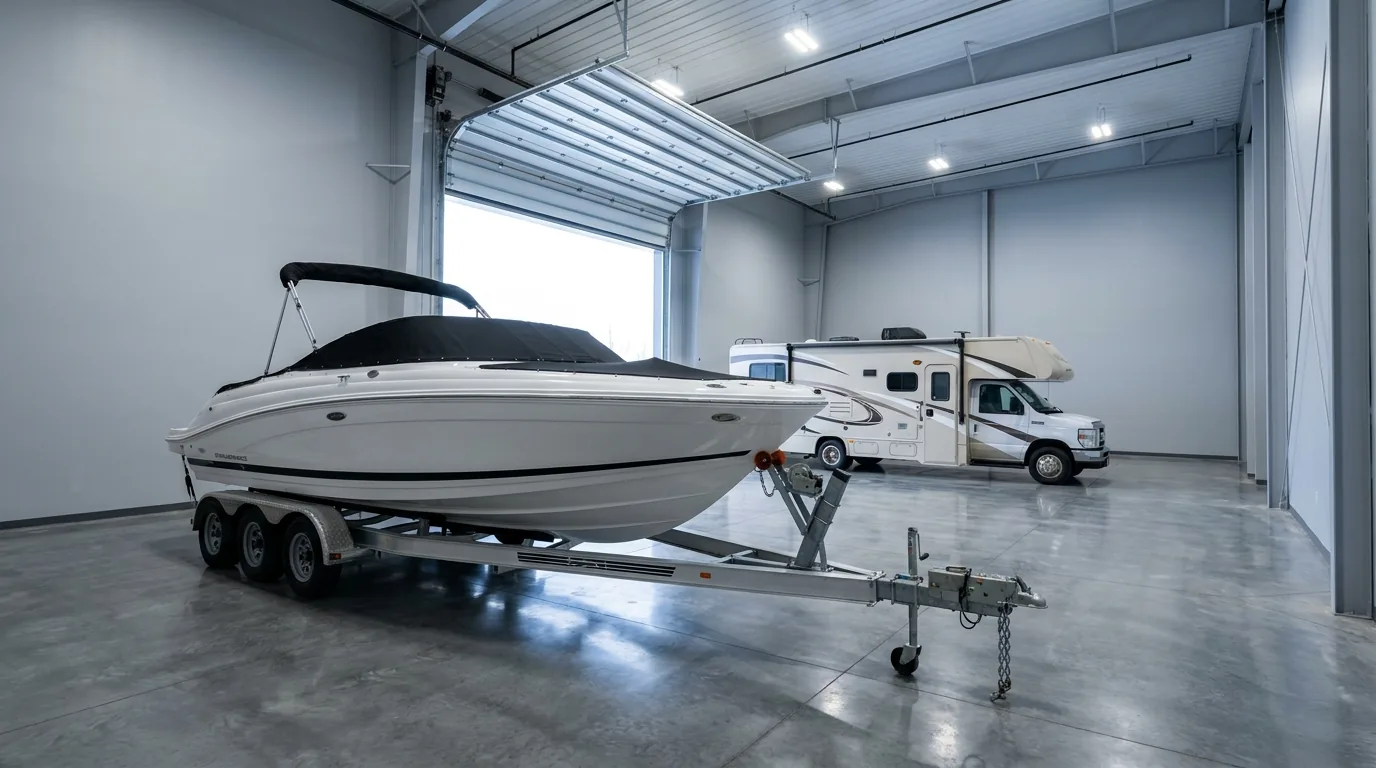
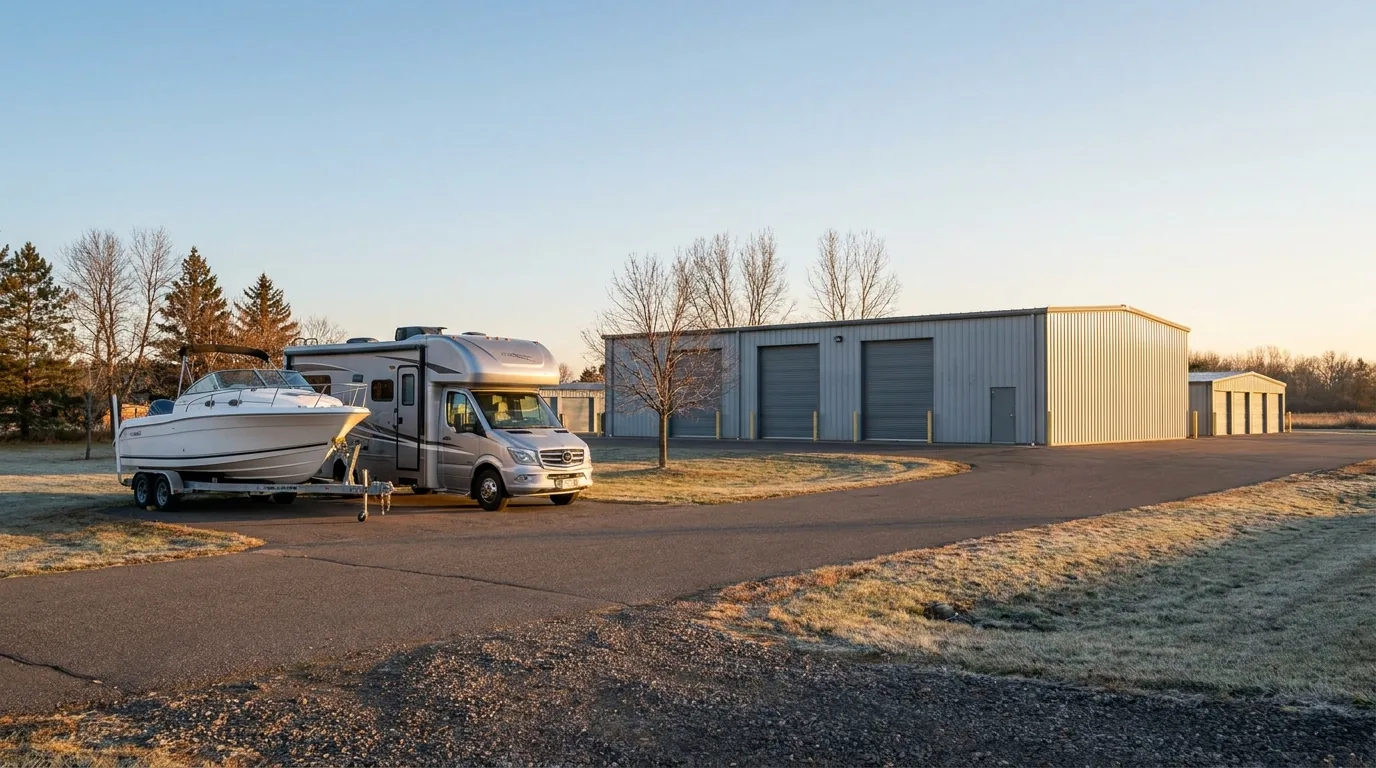
The quick answer: measure your whole rig from bumper to trailer tongue, add a couple of feet of working room, and match that to the next unit size up. For most boats and campers, that lands at a 10×30. For a full motorhome, it is usually a 12×40 or 14×40.
The trap is measuring just the hull or just the coach. The trailer, the tongue, and the height on the trailer are what jam people in the doorway on move-in day.
Picture the first cold Saturday in October. You back the boat up to the unit you reserved over the phone, hop out to swing the door open, and the trailer tongue is still hanging a foot past the threshold. Now you are stuck in the doorway, holding up the line behind you, calling the office to ask if anything bigger is open.
That scene plays out every fall, and it is almost always a measuring problem, not a bad-luck problem. Minnesota stores more boats per person than any other state, with roughly one registered boat for every six residents. [1] Add in the motorhomes, fifth wheels, and pop-ups, and a lot of garages around here simply run out of room by October.
So you start shopping for a unit, and the size chart leaves you guessing. Here is how to size it right the first time.
The One Rule That Decides Your Unit Size
Size to the footprint your rig actually occupies on the ground, not the length printed in the sales brochure. Brochure length almost always undercounts, because it leaves off the trailer tongue, the swim platform, the spare tire, and the bumper rack.
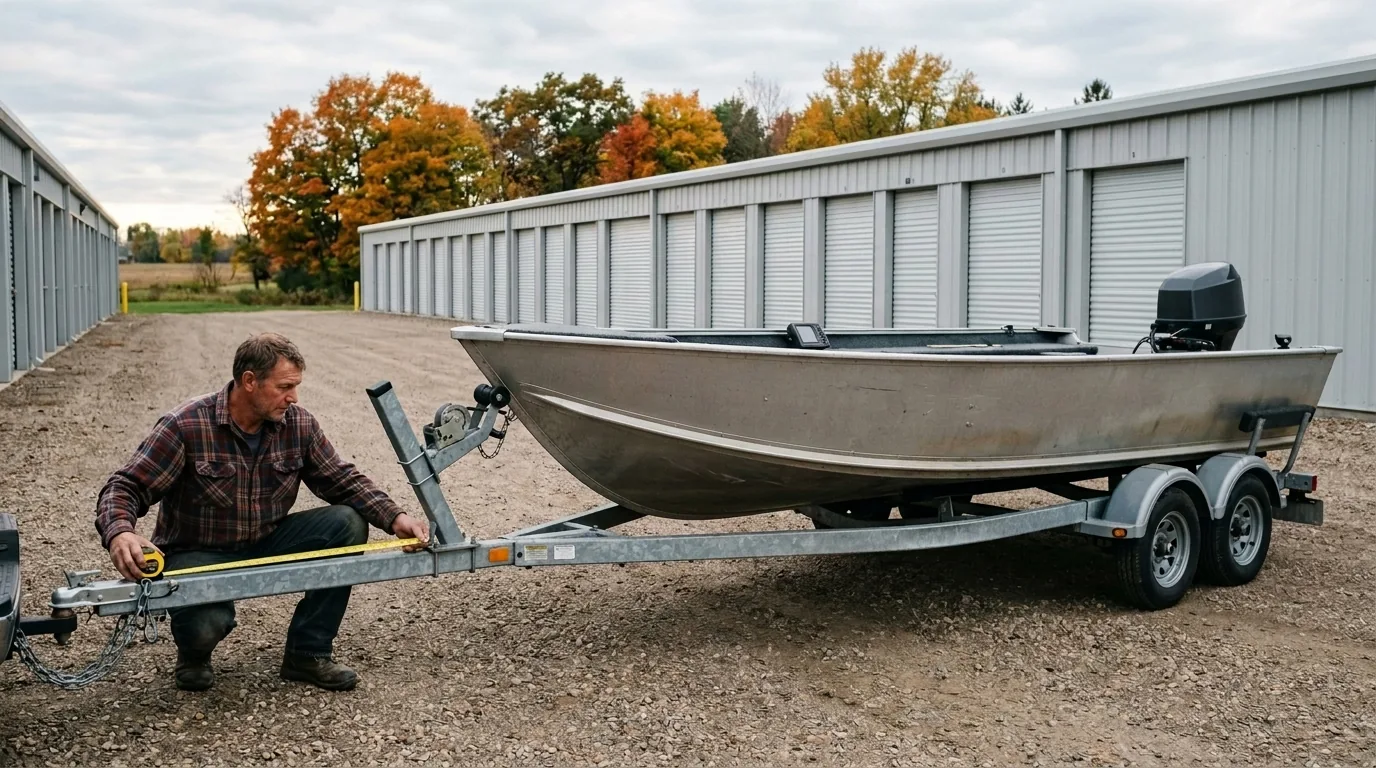
A boat trailer is measured from the coupler at the tip of the tongue all the way to the rearmost point, so the trailer is usually longer than the boat sitting on it. [2] That gap is where the trouble usually starts.
Then add buffer. You want 2 to 4 feet of extra length so you can close the door behind the rig, and about a foot of extra width so you can walk down one side. Snug is not the goal. You will be backing in and out in the dark, in winter gear.
What Size Storage Unit Do I Need for a Boat?
Most trailered recreational boats in Minnesota fit a 10×30 unit once you account for the trailer, and that covers the majority of fishing boats, bowriders, and smaller pontoons. Larger pontoons, wakeboard boats, and cabin cruisers move up to a 12×40.
The two dimensions boaters overlook are the tongue and the beam. The tongue adds 2 to 5 feet of length beyond the hull. Pontoons run wide, often 8.5 to 10 feet across the deck, which eats into a narrow unit faster than length does.
| Boat type | Hull length | Length with trailer | Unit that fits |
|---|---|---|---|
| Jon boat / small aluminum fishing | 12–16 ft | ~16–20 ft | 10×20 |
| Fishing boat / bowrider | 17–20 ft | ~21–25 ft | 10×30 |
| Pontoon (mid-size) | 18–22 ft | ~22–27 ft | 10×30 (watch the width) |
| Ski / wakeboard boat | 20–24 ft | ~24–29 ft | 12×30 to 12×40 |
| Cabin cruiser | 26–32 ft | ~30–37 ft | 12×40 to 14×40 |
Do not forget height. A boat sits up high on its bunks, so a tower, a T-top, or a tall windshield can add several feet. Measure to the highest point and make sure it clears the door, not just the ceiling.
What Size Storage Unit Do I Need for an RV or Motorhome?
RV sizing comes down to class, and the lengths vary a lot. A Class B camper van slips into a 10×30, while a 40-foot Class A diesel pusher needs a 14×40 with a tall door. Class C and most travel trailers land comfortably in the middle.
RV ownership keeps climbing, with U.S. shipments reaching 342,220 units in 2025, up 2.5 percent over the year before. [3] More rigs on the road means more owners hunting for a unit that actually fits in the fall.
Here is the part that trips owners up: length tells you the floor, but height tells you the door. Most RVs stand 10 to 13.5 feet tall. [4] And a travel trailer’s listed length is box length only, so the hitch adds another 2 to 5 feet to what you actually store.
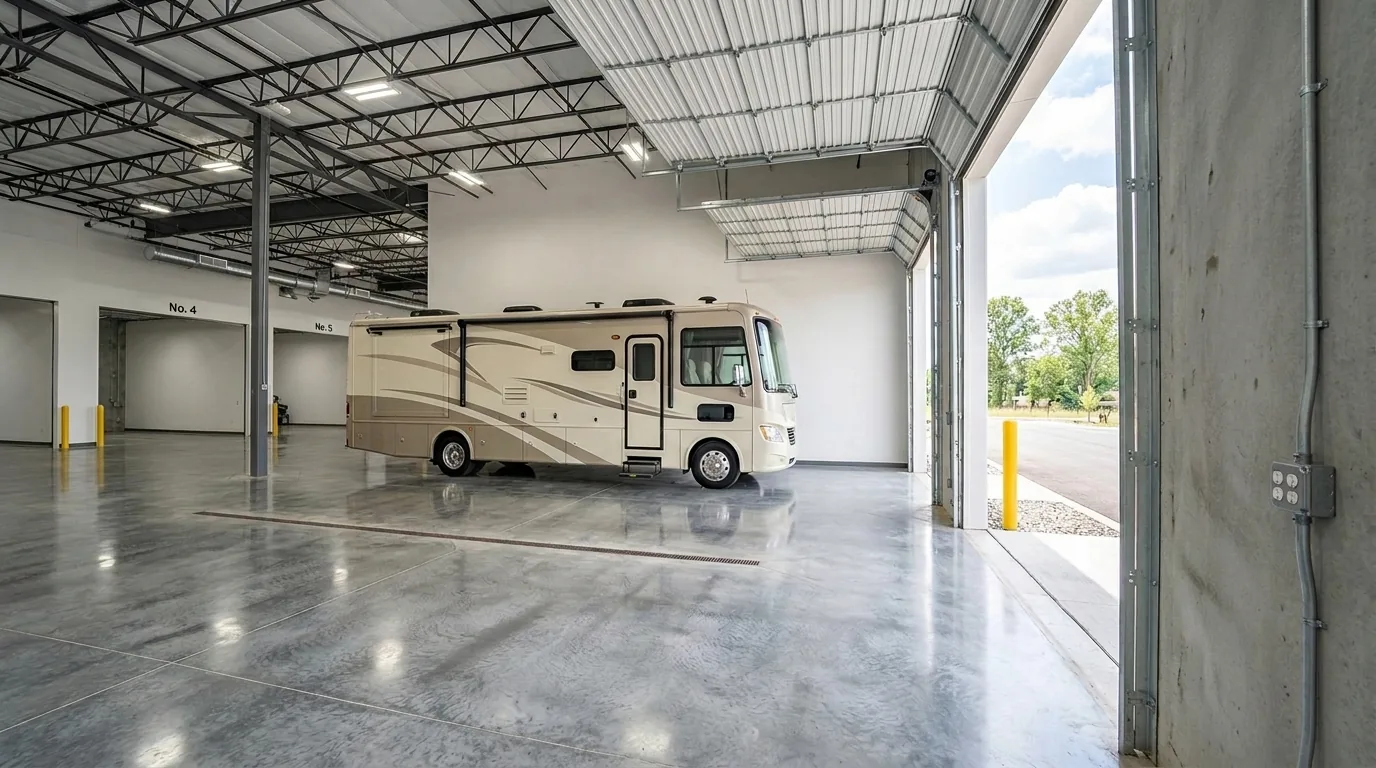
Standard RV width is 8 feet 6 inches, [5] so width is rarely the problem. Door height and total hitched length are what decide whether your motorhome is a 12-foot-wide unit or a 14-foot one.
What Size Storage Unit Do I Need for a Camper or Travel Trailer?
Towables are the most common rigs we store, and they span the widest range. A collapsed pop-up tucks into a 10×20, a mid travel trailer fits a 12×30, and a big fifth wheel or toy hauler needs the full 14×40 with a tall door.
With a camper, the floorplan number is the thing that fools people. A trailer sold as a “26-footer” measures box length only. With the tongue and bumper rack, the real stored length is closer to 29 or 30 feet.
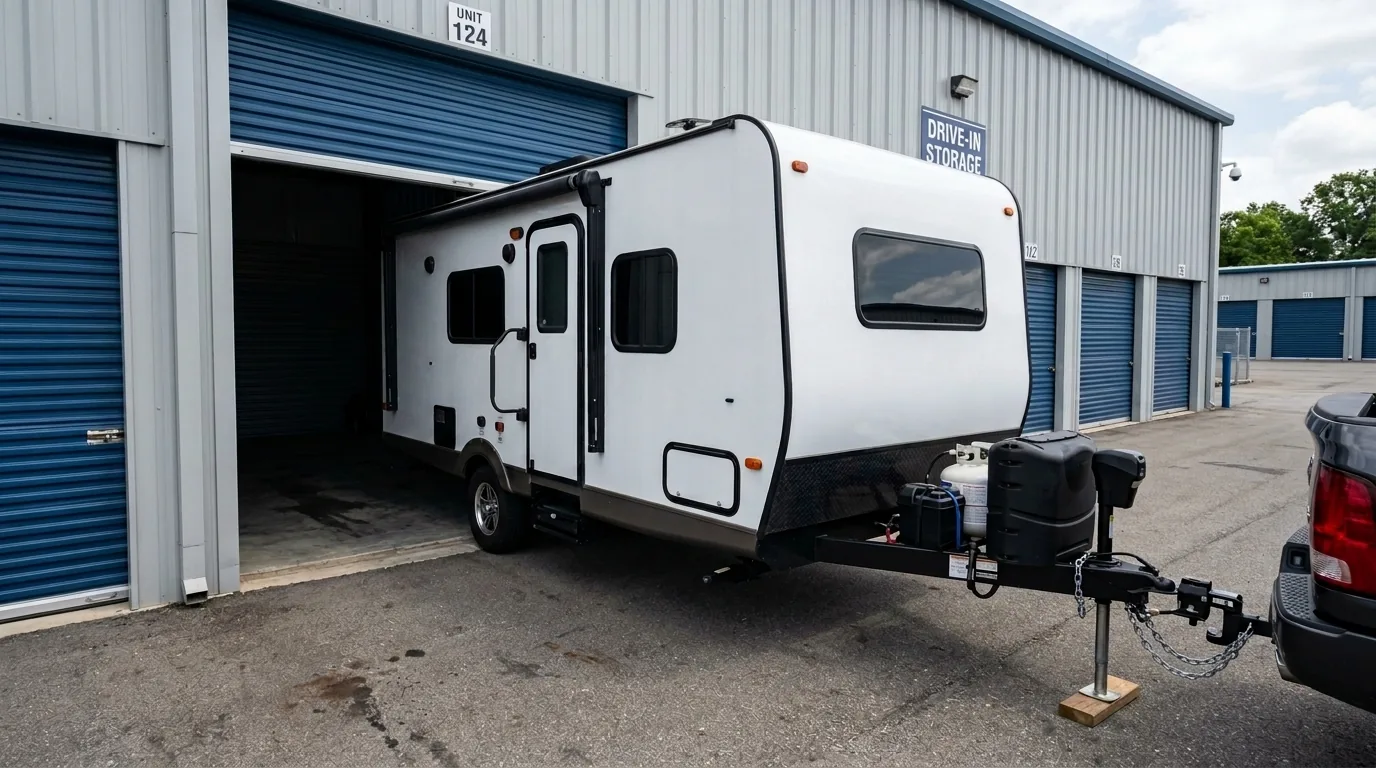
| Camper type | Length (with hitch) | Height | Unit that fits |
|---|---|---|---|
| Pop-up/folding (collapsed) | ~10–18 ft | under 5.5 ft | 10×20 |
| Small travel trailer | ~16–24 ft | 10–11 ft | 10×30 |
| Mid/large travel trailer | ~25–38 ft | 11–13.5 ft | 12×30 to 12×40 |
| Fifth wheel | ~28–48 ft | 12–13.5 ft | 14×40 |
| Toy hauler | ~26–46 ft | 11–13 ft | 14×40 |
Fifth wheels deserve a special note. The kingpin overhang that rides over the truck bed adds height at the front, and the overall length runs long. When in doubt with a fifth wheel, size up.
Storage Unit Sizes and What Actually Fits
Once you have your three numbers, the unit chart gets simple. Storage bays are sold by floor footprint, but for vehicles, the door dimensions matter just as much. Here is how the common sizes shake out for boats, RVs, and campers.
| Unit size | Best for | Rough fit |
|---|---|---|
| 10×20 | Pop-up campers, jet skis, small fishing boats, motorcycles | Rigs under ~18 ft |
| 10×30 | Fishing boats, bowriders, mid pontoons, small trailers, Class B vans | Rigs ~18–28 ft |
| 12×30 / 12×40 | Class C, mid-to-large travel trailers, ski boats | Rigs ~28–38 ft |
| 14×40 | Class A motorhomes, large fifth wheels, toy haulers, big pontoons | Rigs up to ~40 ft, up to ~14 ft tall |
When your measurement falls right on the line between two sizes, take the larger one. The few extra dollars a month buy you a buffer for gear, easier maneuvering, and room to walk around the rig for off-season checks.
Not sure which size you need? We will measure it with you.
Due North Storage offers indoor units up to 14×40 with electricity included, just off Highway 10 in the St. Cloud area. Tell us your rig and we will point you to the right bay.
Why Door Height and Width Matter as Much as Length
A unit can be plenty long and still turn you away at the threshold. The roll-up door opening is almost always shorter than the interior ceiling, so the door clearance is the number that decides whether your rig goes in at all.
Height catches boat owners with towers and RV owners with rooftop air conditioners. A coach listed at 12 feet tall can hit 13 feet once you count the A/C shroud, the antenna, and the trailer height underneath.
Width matters for the wide loads: pontoons, fifth wheels with slide-outs retracted, and dual-axle trailers. You also need room to open a door, walk the side, and not scrape a mirror on the way in.
Why So Many Minnesota Owners Store Off-Site
Two things push boats and RVs out of the driveway here: rules and winter. Many homeowners associations and city ordinances limit how long an RV or boat can sit in a driveway or front yard, and some cap it by length entirely.
Then there is the season. A rig parked outside through a Minnesota winter takes the full beating of snow load, freeze-thaw, and ice. An enclosed unit with power lets you keep a trickle charger on the battery and the cabin dry until spring.
That combination is why the off-season pickup line gets long. The owners who reserved a properly sized indoor unit in October are the ones rolling out clean and ready in May.
Due North runs indoor facilities across central Minnesota, with premium vehicle units in Saint Cloud, Little Falls, Milaca, and Sauk Centre. Each one carries the larger bays that boats, campers, and motorhomes need.
What We See at Due North Storage
The most common sizing mistake we watch happen is the boat owner who measured the hull and forgot the trailer. They booked to the 19-foot number, then showed up with a 24-foot rig and nowhere to put the extra five feet.
Right behind it is the height surprise. A customer is sure their camper “clears 12 feet,” then the rooftop A/C catches the top of the door track. Both are avoidable with one tape measure and five minutes before you reserve.
Our honest advice: bring us your three numbers, length, width, and height as the rig sits hitched. We would rather put you in the right bay on day one than watch you wrestle a too-small door in November.
Frequently Asked Questions
What size storage unit do I need for a 24-foot boat?
A 24-foot boat usually needs a unit around 28 to 30 feet long once you add the trailer tongue, so a 10×30 or 12×30 is the right target. Check the beam too, since pontoons and wider hulls can crowd a 10-foot-wide bay.
Always measure the tallest point with the boat on the trailer to confirm it clears the door.
Will a Class A motorhome fit in a 12-foot-wide unit?
Usually yes on width, since RVs are capped near 8 feet 6 inches, but a 40-foot Class A needs the length and door height of a 14×40 to move in and out easily. Many Class A coaches stand close to 13.5 feet tall.
For a full-size diesel pusher, a 14×40 with a tall door is the safer choice.
How much extra length should I add for the trailer?
Add 2 to 5 feet beyond the hull or camper box for the trailer tongue and coupler. Boats sit on a frame that extends past the stern, and travel trailers list box length only, leaving off the hitch.
When the total lands between two unit sizes, choose the larger one for easier parking.
Does storage unit height really matter for an RV?
Yes, and it is the number owners miss most often. Most RVs stand 10 to 13.5 feet tall, and rooftop air conditioners, antennas, and the trailer height push the real clearance higher.
The roll-up door opening, not the interior ceiling, is the dimension that decides if your rig fits. A 14-foot door clears nearly all of them.
Is an indoor unit worth it over outdoor parking in Minnesota?
For a Minnesota winter, an enclosed unit protects your rig from snow load, ice, and freeze-thaw damage that outdoor parking cannot. Units with electricity also let you keep a battery maintainer running through the off-season.
The protection usually pays for itself the first spring you skip a weather-related repair.
What is the most common RV and boat storage size?
The 10×30 handles most trailered fishing boats, mid pontoons, and smaller campers, while the 14×40 covers the big motorhomes and fifth wheels. Class C rigs and mid travel trailers sit in between at 12×30 to 12×40.
Match the unit to your measured length, width, and height rather than the class name alone.
Reserve the right-sized bay before the fall rush.
Indoor units up to 14×40 with electricity included, just off Highway 10 in the St. Cloud area. Give us your rig’s length, width, and height, and we will get you into the unit that fits.
Sources:
[1] Minnesota Department of Natural Resources. Boating and canoeing facts. Updated May 2025. Retrieved 2026-06-29.
[2] etrailer.com. How to Determine the Length of a Trailer. Retrieved 2026-07-08.
[3] RV Industry Association. RV Shipments End 2025 at 342,220 Units, Modest 2.5% Growth Over 2024. December 2025. Retrieved 2026-06-29.
[4] RecNation Storage. RV Dimensions: Trailer Length, Width, and Height Explained. December 10, 2025. Retrieved 2026-06-29.
[5] Legal Information Institute, Cornell Law School. 23 CFR § 658.15, Width. Retrieved 2026-07-08.